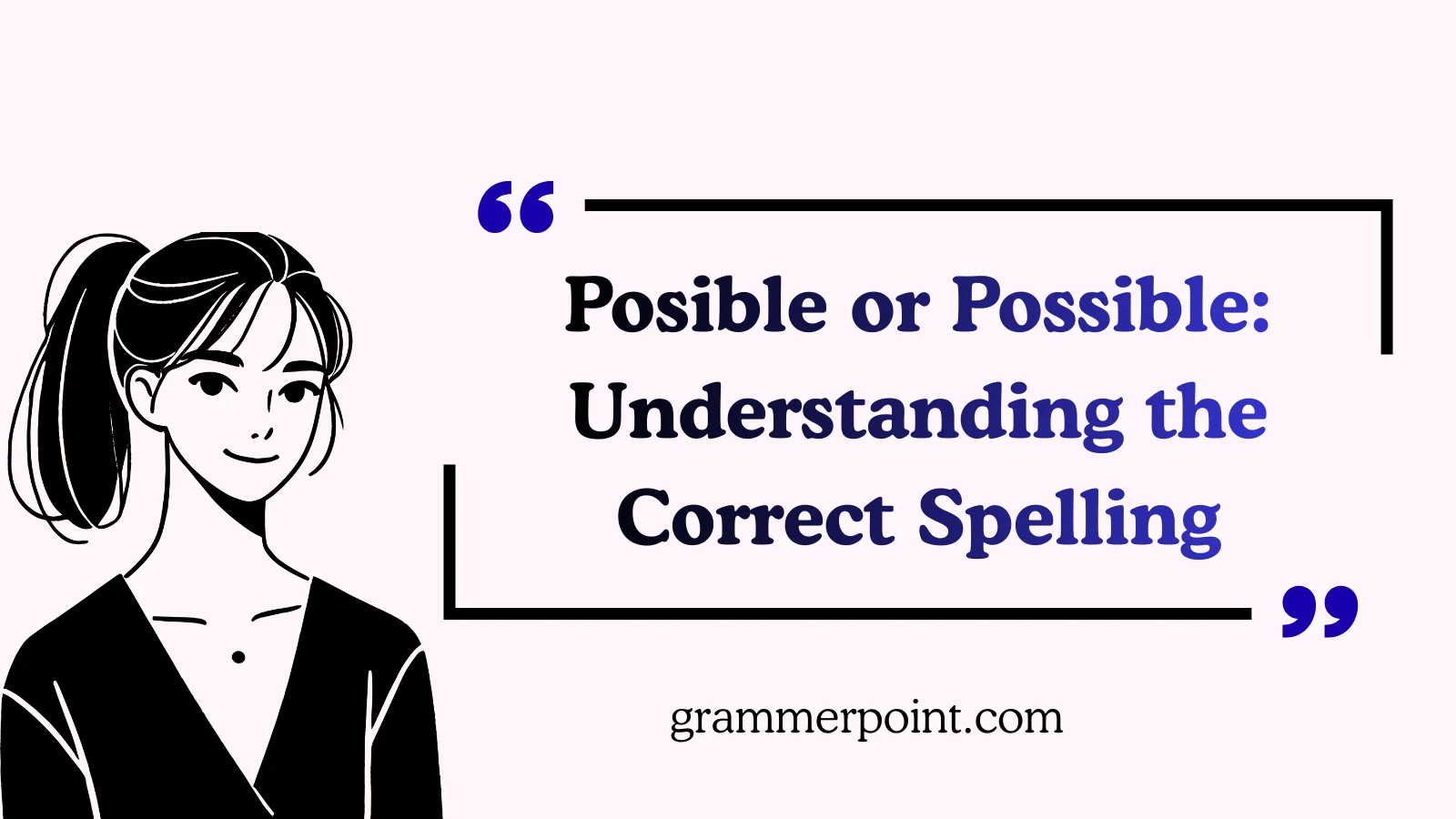
When thinking about Posible or Possible, I often recall how one small spelling slip can confuse readers and weaken clarity in writing tasks.
I’ve seen posible appear in social media posts and even school papers, and I always wondered why this common spelling mistake keeps showing up. The debate usually arises from how the English language works, with its unpredictable differences, hidden typographical errors, and the pressure of professional or academic writing, where choosing the proper and correct term reflects both credibility and precision. Over time I relied on the dictionary as a quick guide whenever I needed to know the answer, remember tricky words, or confirm the right usage and title of something important.
Most mix-ups between possible and posible come from a lack of clarity, not a lack of understanding. One missing “s” shows how tiny details matter, especially when you want to write confidently. I’ve seen this in client drafts, where small slips made them wonder what caused the error. That’s why I often share tips to prevent these pitfalls, like remembering the double “s” by linking it to “mission” or “passion,” which helps you store the word forever so you never feel alone with spelling again.
Posible or Possible: What’s the Difference?
The difference hinges on accuracy. Possible is correct in English. Posible isn’t valid in English spelling, even though it looks convincing at a glance. The confusion rises because English borrows heavily from Latin and French, where double consonants are common yet unpredictable.
Readers often rely on how a word sounds, not how it’s structured, which creates more chances for error. When you compare posible or possible, one feels visually lighter while the other follows established patterns of English morphology.
Posible or Possible: Why “Posible” Appears as a Common Misspelling
People misspell words for several reasons. The confusion between posible or possible tends to emerge from:
- Influence from Spanish — In Spanish, posible (with one S) is correct. Bilingual speakers often transfer that pattern unconsciously.
- Sound-based assumptions — Many English learners think the double S adds no extra sound so they remove it.
- Typing shortcuts — Fast typing sometimes leads to the omission of a repeated letter.
- Pattern mismatch — English doesn’t always use doubled consonants, so learners avoid them unless necessary.
This mix of linguistic habits and phonetic logic produces one of the most widespread spelling mistakes online.
Posible or Possible: Why “Possible” Is Always Correct in English
The word possible entered English from the Latin possibilis. Latin used double consonants to show morphological boundaries, and English kept that structure. The double S also reflects a broader English rule: after certain vowel patterns, English doubles the consonant to preserve pronunciation.
When comparing posible or possible, the latter aligns with:
- Etymology
- English spelling conventions
- Standard dictionary forms (Merriam-Webster, Cambridge, Oxford)
- Every formal, academic, and professional writing standard
So whenever you write anything in English—emails, essays, captions, or business reports—choose “possible.”
Posible or Possible: Key Characteristics of the Correct Spelling “Possible”
To help you internalize the correct form, here are the defining attributes of possible.
Spelling
- P-O-S-S-I-B-L-E
Syllables
- pos-si-ble (three syllables)
Pronunciation
- /ˈpɑːsəbəl/ (American English)
Part of Speech
- Adjective
Typical Contexts
- Everyday conversation
- Academic writing
- Business communication
- Creative writing
- News, media, and broadcasting
These features reinforce why possible remains the proper selection when comparing posible or possible.
Posible or Possible: How to Spell “Possible” Correctly Every Time
You can lock the spelling into your memory by following a simple rhythm. Break it into mini-chunks:
POS + SI + BLE
Or use one of these techniques:
- Double the S because the word has double potential.
- Think of the word “mission.” Both share a double S.
- Remember: “It’s possible to misspell possible.” The double S stands out.
If you regularly wonder about posible or possible, lean into patterns you already know: English uses doubled consonants in hundreds of everyday words—mission, lesson, pressure, assume, and impossible.
Posible or Possible: Most Common Misspellings
Here’s a list of the most frequent incorrect variations, along with why they happen:
| Misspelling | Why It Happens |
| Posible | Spanish influence or phonetic spelling |
| Possable | Confusion with -able ending patterns |
| Possibel | Germanic spelling interference |
| Posibel | Overgeneralization from similar English words |
| Possibl | Truncation error in fast typing |
| Posibble | Adding extra letters due to uncertainty |
These variations surface often in search queries, informal writing, and ESL environments, which fuels the ongoing posible or possible confusion.
Posible or Possible: Understanding the Meaning of “Possible”
The word possible describes anything that can happen, exist, or be achieved under given conditions. It expresses capability, opportunity, or feasibility.
Definition
“Something is possible when it falls within the limits of what can occur, be achieved, or be true.”
Real-world examples
- It’s possible to finish a large project with good planning.
- You may not know the outcome yet but progress is always possible.
- The weather forecast shows a possible chance of rain.
Whenever you need to describe potential outcomes or feasible situations, possible is the accurate choice—not the single-S variant.
Posible or Possible: Synonyms for “Possible”
Different situations call for specific shades of meaning. Here’s a helpful list:
- Feasible
- Achievable
- Attainable
- Realistic
- Conceivable
- Doable
- Likely
- Plausible
- Potential
- Workable
Use these synonyms when you want to add nuance without repeating the same adjective throughout your writing.
Posible or Possible: Side-by-Side Comparison Table
Here’s a quick visual breakdown so you never mix them up again.
| Feature | Posible | Possible |
| Correct in English | ❌ No | ✔ Yes |
| Part of Speech | Invalid | Adjective |
| Meaning | None in English | Capable, doable, feasible |
| Origin | Spanish spelling | Latin → French → English |
| Use in Formal Writing | Never | Always |
| Dictionary Recognition | No | Yes |
| Example Sentence | — | “Anything is possible with effort.” |
If you compare posible or possible, the contrast becomes crystal clear.
Posible or Possible: Detailed Comparison and Spelling Correctness
When diving deeper into linguistic accuracy, the distinction becomes even more meaningful.
- Possible follows a predictable Latin-based spelling pattern used in English for centuries.
- Posible fits the orthographic rules of Spanish, not English.
- English relies on consonant doubling to maintain vowel clarity, which is why the single-S version doesn’t work.
- The double S ensures that the first vowel remains short. Without it, the pronunciation wouldn’t match the intended meaning.
This analysis shows why there’s no debate: possible stands as the sole correct form.
Posible or Possible: Language-Specific Usage
Understanding cross-language variations helps avoid mix-ups.
- English: “possible”
- Spanish: “posible”
- French: “possible”
- Portuguese: “possível”
- Italian: “possibile”
Because bilingual speakers sometimes switch between languages, their writing transfers habits from one system to another, deepening the posible or possible confusion.
Posible or Possible: Examples in Sentences
These examples will help you get comfortable with the word in action.
- “It’s entirely possible to succeed when you stay persistent.”
- “She asked whether a solution was possible within the deadline.”
- “They didn’t know if travel was possible during the storm.”
- “The team explored every possible option before deciding.”
Use these patterns to reinforce consistent spelling.
Posible or Possible: Why Confusion Happens
People mix up spellings for predictable reasons:
- Visual similarity between both forms
- Bilingual interference
- Auto-correct tools that sometimes fail
- Uncertainty about English double-letter rules
- Overreliance on phonetic spelling
- Quick typing that drops repeated consonants
Once you know the triggers, you can correct them easily.
Posible or Possible: Examples in Everyday Usage
Let’s bring this into daily life.
- In a text message: “Is it possible to meet today?”
- In a business email: “We believe it’s possible to complete this in two days.”
- On social media: “Anything’s possible when you stay intentional.”
- In school writing: “The scientists studied every possible explanation.”
Notice how natural the correct spelling feels in these situations.
Posible or Possible: Tips to Avoid the Spelling Error
Use these strategies:
- Slow down when writing important content
- Reread your sentence out loud
- Compare difficult words to similar correct patterns
- Make a proofreading checklist
- Use memory anchors
- Practice writing the correct spelling a few times
Consistency removes uncertainty.
Posible or Possible: Usage in Literature and Media
The word possible appears across famous works, speeches, and films.
Examples
- “Everything is possible. The impossible just takes longer.”
- “With the right mindset anything becomes possible.”
Because the word shows up in inspirational content, it reinforces the idea of opportunity and potential.
Read More: Batton or Baton: The Correct Spelling Explained Clearly
Posible or Possible: Related Misspellings and Variations
Here are similar mistakes people make:
- Impossible → imposible
- Possibly → posibly
- Possibility → posibility
- Impossible → impossable
- Possibly → possibley
These errors follow the same pattern as posible or possible—the double consonant gets lost.
Posible or Possible: How to Avoid Spelling Pitfalls
Here’s a reliable system:
- Recognize double-letter patterns
- Study the root “poss-”
- Focus on rhythm: POS-SI-BLE
- Look at surrounding word families: possible, possibly, possibility
- Train your eyes to spot the double S
Over time this becomes second nature.
FAQs:
Is “posible” ever correct in English?
No. It’s only correct in Spanish. In English, use “possible.”
Why does “possible” have two S’s?
It keeps the short vowel sound and follows its Latin origin.
Is “posible” correct in Spanish?
Yes. Spanish uses the single-S form.
What’s the fastest way to remember the spelling?
Think: “Double the S because success has two S’s.”
Why do English learners mix these spellings?
Because they rely on phonetics instead of established spelling rules.
Conclusion:
Choosing between posible and possible may seem like a small detail, yet these small choices shape how clearly your message comes across. When you slow down and pay attention to spelling, you strengthen your writing and show readers you care about accuracy. Over time this builds your confidence, whether you’re writing for school, work, or personal projects. Each careful decision improves your overall communication and reduces the chance of repeating the same mistakes.
The more you practice correct spelling, the more natural it becomes. With simple habits like checking a dictionary, noticing patterns, or remembering the double “s,” you’ll find that tricky words no longer slow you down. Staying aware of these details helps you grow as a writer and makes your work easier for others to understand.

Emma Brooke is a passionate writer and language enthusiast who loves helping people improve their English. She shares simple tips, clear explanations, and practical advice to make learning grammar easy and fun.