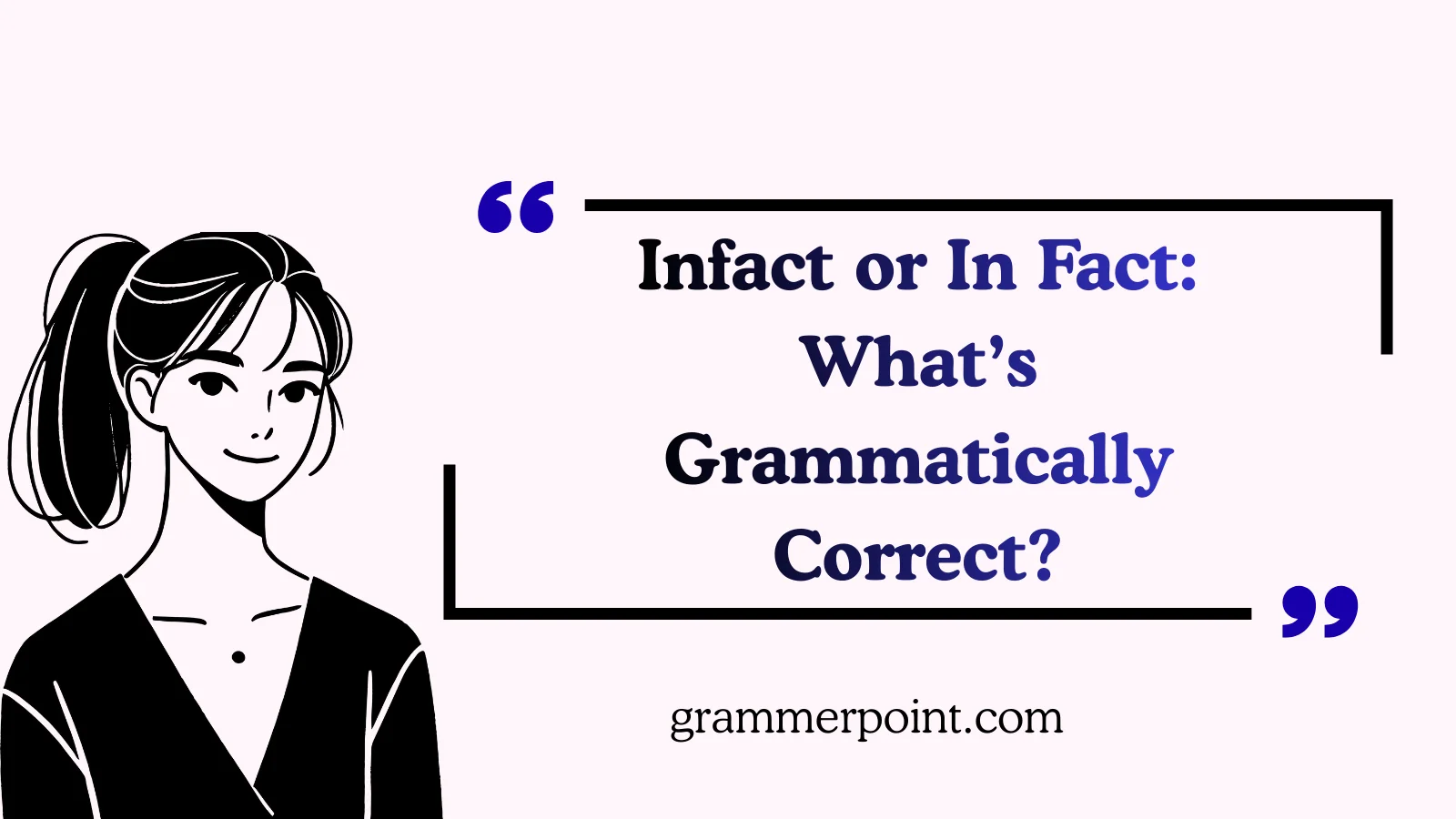
The phrase in fact is commonly used and often misspelled as Infact or infact. Infact or In Fact shows why only one correct spelling exists and how a tiny space between two words truly matters.
From a grammar and correctness point of view, in fact follows clear syntax rules. Through years of editing, I gained valuable insights into how it affects communication skills. It works as a modifier, adds additional information, and fits an adverbial phrase. This usage adds emphasis, shapes semantics, and acts as a versatile word in written discourse. With practical examples, context builds understanding, turning it into a linguistic tool you can master to enhance clarity.
In emails, reports, and formal writing, this distinction is important. I still encounter this mistake when using infact instead of in fact, which causes clarification issues. Two forms may appear, but one correct phrase makes the difference and ensures clear communication in various situations, shaping meaning without confusion.
Quick answer:
Write in fact — two words. Infact is not a standard English word. This guide explains why, shows correct usage, compares related phrases, and gives practical memory tricks and proofreading tactics so you never make the mistake again.
Ever paused while typing and wondered whether to use infact or in fact? You’re not alone. Small spacing errors like this trip up writers of every level. They can weaken credibility, distract readers, and trigger grammar flags in automated tools.
This article clears up the confusion. You’ll learn the meaning, correct placements, punctuation rules, and how in fact differs from similar expressions like as a matter of fact. You’ll also get practical editing tips, memory tricks, real-world examples, and short exercises to cement the rule.
Read on to stop the guesswork and use in fact with confidence.
Understanding the basics
What “in fact” means
In fact is an adverbial phrase used to:
- Add emphasis to a statement.
Example: In fact, the study showed a 30% improvement. - Correct or reinforce a previous claim.
Example: She said it was late. In fact, the meeting had already started. - Present information that clarifies a misconception.
Example: Many think the product is expensive. In fact, the price fell last year.
The core idea is clarifying reality or strengthening truth.
Why “infact” is incorrect
Infact—written as one word—does not appear in standard modern English dictionaries. It’s a typo or a contraction error, not an accepted spelling. Search engines, spell-checkers, and style guides flag it as wrong. Treat it like a misspelling.
Common causes of the error:
- Fast typing or autocorrect merging the words.
- Misunderstanding the phrase as a single lexical item.
- Transfer errors from languages where comparable expressions are written as one word.
Bottom line: always use two words: in fact.
Correct usage of “in fact”
Below are clear patterns for using in fact with examples you can copy into your writing.
At the start of a sentence for emphasis
Use in fact at the beginning when you want to lead with a clarifying point.
- In fact, remote teams reported higher productivity last quarter.
- In fact, charging the battery fully can shorten its lifespan.
Within a sentence to add emphasis or correction
Place in fact mid-sentence when you’re tightening a claim or inserting clarification.
- The plan, in fact, was ready two weeks early.
- She wasn’t late in fact she arrived before everyone else.
Note: When in fact appears mid-sentence it often sits between commas. The commas set it off as an interrupter.
After a contrast or to contradict
Use in fact to correct a preceding claim or contrast with expectations.
- You might expect high costs. In fact, expenses dropped by 15%.
- We thought it was finished. In fact, several tasks remain.
With formal or academic writing
In fact is appropriate in formal writing but use it sparingly. Overuse weakens tone and reads like filler.
Useful alternatives for academic tone:
- Indeed
- As a matter of fact (slightly more conversational)
- Notably
Punctuation rules and placement details
Punctuation can change rhythm and emphasis. Here are practical rules.
Using commas with “in fact”
- At the start of a sentence: follow with a comma.
Example: In fact, sales rose following the update. - As a mid-sentence interrupter: place commas on both sides.
Example: The report, in fact, contradicts the initial claim. - When in fact closes a sentence: no comma before it unless grammar requires.
Example: The test showed the opposite in fact it proved our theory wrong. — This feels awkward. Better: The test showed the opposite. In fact, it proved our theory wrong.
Avoid placing a comma before coordinating conjunctions like and when they join independent clauses. For example do not write: The data was solid, and in fact, convincing. Instead write: The data was solid and, in fact, convincing.
Common placement errors
- Tucking in fact into a place that breaks flow.
Awkward: She in fact was the better candidate. Better: She was, in fact, the better candidate. - Overusing commas around in fact where none are needed. Use them to signal interruption or emphasis not filler.
Comparison: “in fact” vs similar phrases
This quick table shows differences in meaning, register, and punctuation.
| Phrase | Meaning / Use | Register | Punctuation tips | Example |
| in fact | Clarify or emphasize truth | Neutral to formal | Comma after at sentence start; commas if interrupting | In fact, the figure is higher |
| as a matter of fact | Emphasize a point often informally | Informal to neutral | Commas optional; longer phrase so use sparingly | As a matter of fact, I already mailed it |
| indeed | Strong confirmation, formal | Formal | No commas necessary but can be used for emphasis | Indeed, the results were conclusive |
| actually | Correct or soften a correction | Informal | Often used with commas | He is, actually, a certified trainer |
| infact | Incorrect | Not applicable | Avoid entirely | — |
Common mistakes and how to fix them
Top errors writers make
- Writing infact as one word.
- Overusing in fact as filler.
- Incorrect punctuation that disrupts flow.
- Confusing in fact with as a matter of fact and using them interchangeably.
Quick fixes
- Run a find-and-replace for “infact” in your document. Replace with “in fact” then re-read for flow.
- If in fact appears more than twice in a short section replace some instances with indeed, actually, or rephrase.
- When in doubt, read the sentence out loud. If in fact feels tacked on, restructure.
Memory tricks to remember the correct form
Use one of these simple cues to lock the rule into your writing habits.
- Think of two concepts: something in your mind and a fact about it. That separation reminds you to write two words.
- Visual spacing: picture putting a small gap in the phrase to breathe. That tiny space is the correct form.
- Keyboard habit: slow down when typing “in” then press space before typing “fact.” The act itself prevents your fingers from mashing them together.
- Mnemonic: “In reality, it’s a Fact.” The capitals remind you of the two separate words.
Proofreading checklist
Use this checklist when editing to catch mistakes fast.
- Search for infact with find. Replace or correct each instance.
- Check punctuation around in fact. Are commas used intentionally?
- Replace redundant uses with synonyms.
- Read aloud each sentence containing in fact. Does it sound natural?
- If writing formally, consider substituting indeed or restructuring the sentence.
Practical rewriting examples
Below are real-world examples that show incorrect use and clean rewrites.
Example 1 — Email draft
Incorrect: Infact we sent the invoice last week and you should have received it.
Fix: In fact, we sent the invoice last week and you should have received it.
Improved version: We sent the invoice last week. In fact, it was mailed on April 3.
Example 2 — Academic sentence
Incorrect: The samples were contaminated infact that affected the results.
Fix: The samples were contaminated, in fact, which affected the results.
Improved version: The samples were contaminated. In fact, contamination altered the results.
Example 3 — Social post
Incorrect: Infact the code runs faster after the update.
Fix: In fact, the code runs faster after the update.
Improved version: The update sped things up. In fact, run time dropped by 25%.
Case studies
Case study 1: Student essay that gained clarity
Context: A college student submitted a biology paper containing multiple runs of “infact.” The professor marked it down for sloppy writing.
Action: The student searched and replaced every “infact” and restructured several sentences where in fact had been forced in.
Result: The revised essay read more clearly and earned a higher grade for clarity and style.
Lesson: Small spacing errors undermine credibility. A quick edit can change the reader’s perception of the entire work.
Case study 2: Marketing email boost
Context: A product team sent an email that used in fact five times within a short paragraph. The message felt repetitive and pushy.
Action: The team replaced two instances with indeed and reworded one sentence to remove the phrase entirely.
Result: Open rates stayed the same but click-through improved. Recipients found the tone cleaner and more convincing.
Lesson: Even correct phrases can be overused. Variation improves persuasion.
Short exercises to practice
Try these quick drills to build accuracy.
- Find three sentences you wrote recently. Replace any “infact” with the correct form and read the sentence aloud.
- Rewrite a paragraph that uses in fact twice in different spots. Try using indeed or actually for variety.
- Create three sentences using in fact at the start, middle, and end. Check punctuation.
Style guidance and tone choices
- Use in fact sparingly in formal writing. It’s useful but can sound repetitive.
- Match tone to audience. In marketing you may use it for emphasis. In academic writing prefer indeed for variety.
- When editing read sentences aloud. The ear catches awkward placement faster than the eye.
Read More: Pick Up vs Pickup vs Pick-Up: The Correct Way to Use Each
Helpful list of synonyms and when to use them
- Indeed — formal emphasis
- Actually — casual correction or surprise
- As a matter of fact — conversational, slightly defensive
- In reality — to contrast with misconception
- Truthfully — when adding sincerity
Use synonyms to vary tone and avoid repetition.
Quick reference table: examples to copy
| Use case | Example to copy |
| Start of sentence | In fact, the tests confirmed the hypothesis. |
| Mid-sentence emphasis | The product, in fact, exceeded expectations. |
| Correct a misconception | She seemed shy. In fact, she led the team. |
| Replace repetition | Instead of repeating in fact, use indeed. |
FAQs:
1. Is “infact” a correct word?
No, infact is not correct. The correct form is in fact, written as two words.
2. Why do people often write “infact” instead of “in fact”?
It’s a common mistake in casual writing and texting because people overlook the tiny space between the words.
3. What does “in fact” mean in a sentence?
In fact adds emphasis or introduces additional information that clarifies or strengthens a point.
4. Can “in fact” be used in formal writing?
Yes, in fact is grammatically correct and widely used in emails, reports, and other formal writing.
5. How can I remember the correct spelling of “in fact”?
Remember that space changes meaning. Think of it as an adverbial phrase, not one word, and you’ll write with confidence.
Conclusion:
Understanding the difference between Infact and in fact is a small detail with a big impact. That tiny space between the two words decides whether your writing looks clear and correct or careless and confusing. In fact is the only correct form, and it works as a useful adverbial phrase that adds emphasis, clarification, and strong meaning to a sentence. When you use it properly, your grammar, syntax, and overall writing quality instantly improve.
By paying attention to this common mistake, you build better communication skills and gain confidence in both casual and formal writing. Whether you’re writing emails, reports, or everyday messages, choosing the correct phrase helps ensure clear communication in various situations. Mastering small grammar rules like this one turns simple words into a powerful linguistic tool that makes your writing sound natural, professional, and trustworthy.

Benjamin Harris is a passionate writer and grammar enthusiast who loves helping people write clearly and confidently. Through Grammar Heist, he shares tips, tricks, and easy-to-follow guides to make writing simpler and more fun.