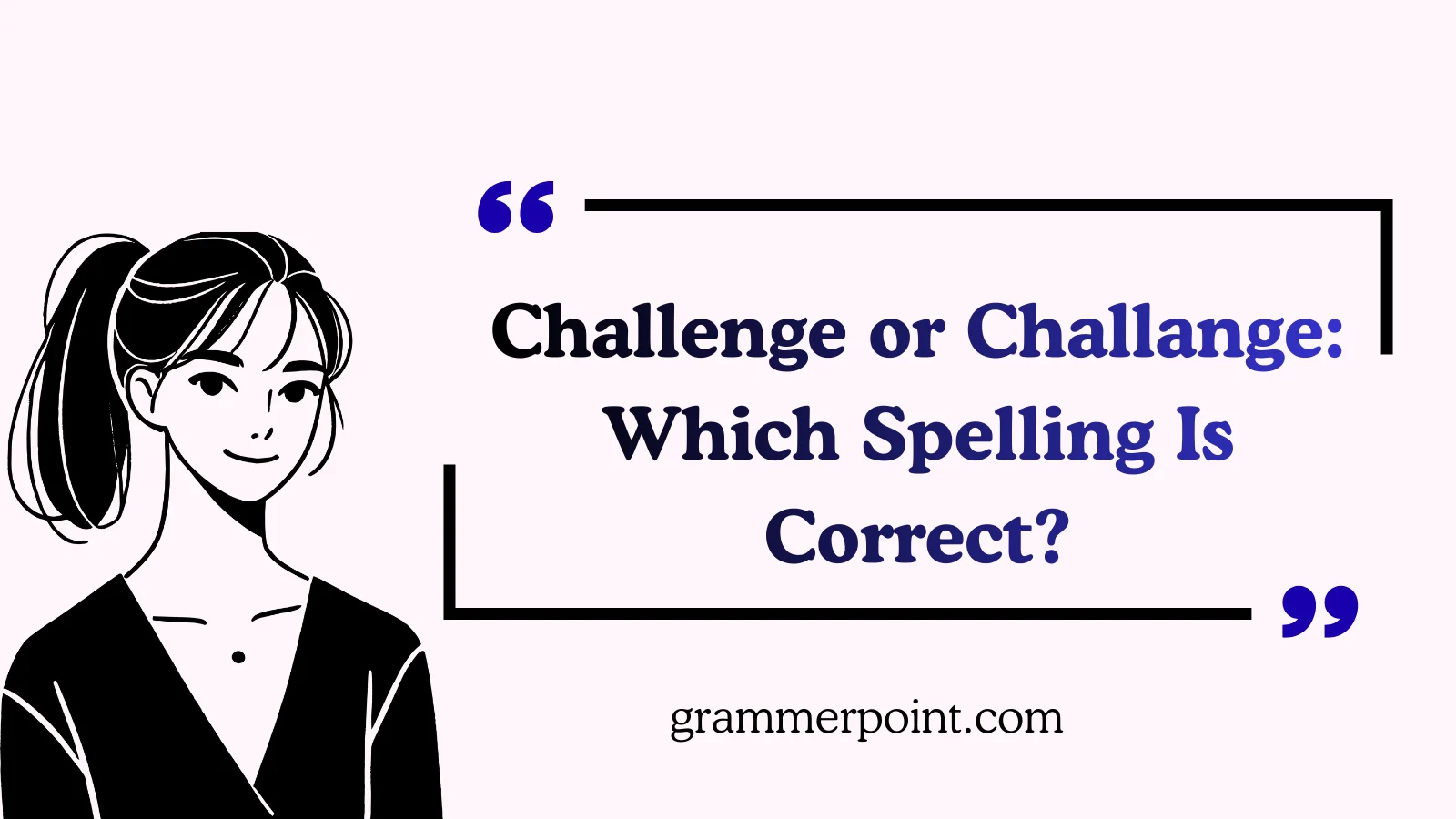
The mix-up between the two spellings in Challenge or Challange shows how a tiny error can shift meaning and weaken trust in writing.
As I teach new learners, I often see how pronunciation, meanings, and small habits shape their spelling choices. Many remember the word as a noun or verb, but still slip an extra letter into it, especially when they try to use it in proper English language tasks like writing emails, school work, or job applications. The moment someone adds that extra “a,” the tone changes, even if the mistake looks harmless.
Through years of guiding students, professionals, and beginners, I’ve learned that sharing practical tips, exploring the word’s origins, and showing examples help them avoid second-guessing themselves. My own writing journey taught me that small details build trust and show care, because one tiny slip can change the whole meaning.
Understanding the Confusion: “Challange” vs “Challenge”
You’re not alone if you’ve typed challange before. In fact, search engines predict the wrong spelling before the right one. That happens for a few reasons.
First, the word challenge doesn’t match its pronunciation perfectly. The middle vowel sound feels like a light “uh,” so the brain wants to insert an a, which leads to challange.
Second, English spelling patterns create false confidence. If you write words like manage, orange, strange, or advantage, your mind recognizes the familiar “-ange” ending. So when you hear a similar sound in challenge, your brain fills in the pattern automatically.
Finally, double consonants cause confusion. English uses them inconsistently, and that inconsistency triggers frequent spelling mistakes.
Here’s where readers usually get thrown off:
- Correct: challenge
- Incorrect: challange
- The “e” after the double “l” signals a different vowel sound than “a.”
This subtle difference leads to one of the most common modern spelling errors.
The Correct Spelling: “Challenge”
The only accepted spelling in English—American, British, Australian, Canadian, or otherwise—is challenge. No major dictionary lists challange as a variant or alternative.
Definition of Challenge
The word challenge has multiple meanings. Its flexibility is a major reason it appears so often in writing.
You’ll see it used as both a noun and a verb:
As a noun:
A test, difficulty, or something that requires effort, skill, or determination.
Examples:
- “Completing the marathon was a huge challenge.”
- “Rising costs present a challenge for small businesses.”
As a verb:
To question, test, confront, or dispute something.
Examples:
- “They challenged the results of the experiment.”
- “The coach challenged the call.”
Related forms include:
- challenging
- challenged
- challenger
Here’s a table for clarity:
| Form | Part of Speech | Example Sentence |
| challenge | noun | “This project is a big challenge.” |
| challenge | verb | “I challenge you to try again.” |
| challenging | adjective | “It was a challenging job.” |
| challenged | adjective | “They felt challenged by the task.” |
| challenger | noun | “The challenger won the match.” |
These forms all follow the same root spelling. None ever contain “-ange.”
Usage of Challenge
The beauty of the word challenge lies in its versatility. It shows up in everyday talk, formal writing, legal documents, workplace communication, sports commentary, motivational speeches, and more.
In conversation, you’ll hear people say things like:
- “I love a good challenge.”
- “That class really challenged me.”
- “We’ve got a challenge ahead.”
Its tone also adapts well. It can sound serious, casual, motivational, or confrontational depending on context.
Etymology of Challenge
The history behind challenge explains everything.
The term stems from the Old French word “chalenge” (later “challenge”), meaning accusation, claim, dispute, or to call into question. Dig deeper and you find the Latin root “calumniari,” meaning to accuse falsely.
Over centuries, English speakers shifted the meaning toward testing, confronting, or demanding effort. That shift created the modern sense we use today.
The -enge spelling survived while the -ange pattern developed independently in unrelated words like orange and strange. That’s why “challenge” doesn’t follow the “-ange” rule.
Why “Challange” Is Incorrect
Now you know the origin of the correct spelling. Here’s why challange will always be wrong.
1. English Morphology Doesn’t Support It
No form of the word has ever used “-ange.”
That means:
- challanging
- challanged
- challanger
are all incorrect too.
The core word controls every variation.
2. The “-ange” Ending Changes Meaning in English
Words ending in -ange usually come from Germanic or Old Norse roots, not French. Because challenge comes from French, it doesn’t share the pattern.
3. Spellcheck Flags It Everywhere
Unlike some informal misspellings (like “alot”), challange is never accepted digitally. Autocorrect tools, grammar checkers, and professional writing apps universally treat it as an error.
4. No Dictionary Recognizes It
- Merriam-Webster
- Cambridge Dictionary
- Oxford English Dictionary
- Collins
- Dictionary.com
None list challange as a real word.
5. No English Inflection Uses “-ange”
Words derived from “challenge” maintain the root:
- challenge
- challenging
- challenged
- challenger
The “a” simply never appears.
Why People Misspell “Challenge” as “Challange”
Spelling errors aren’t random. They follow predictable patterns. The mistake challange comes from three main sources.
1. Phonetic Confusion
When pronounced casually, “challenge” sounds like:
CHAL-enj (short, soft “e”)
The middle “e” isn’t pronounced strongly. It blends into a neutral sound. That encourages inexperienced writers to guess incorrectly.
2. Pattern Borrowing from Other Words
The brain loves shortcuts. When you’ve spelled:
- manage
- advantage
- strange
- change
- arrange
your memory tries to copy the pattern. That leads to accidental overgeneralization.
3. ESL Learning Patterns
English learners often misapply rules because their native language handles vowel sounds differently. When the “e” isn’t pronounced clearly, learners assume the spelling must be different.
4. Muscle-Memory and Typing Errors
Fast typists often hit “a” instead of “e,” especially on mobile keyboards.
Common Misspellings and Close Variants
Here are the most frequent mistakes:
| Incorrect Spelling | Why It Happens |
| challange | Overgeneralization from “-ange” words |
| challanging | Mistaken belief that verb forms shift spelling |
| challanged | Incorrect assumption based on past-tense patterns |
| challanger | Confusion with “manager/singer” endings |
| chalinge | Phonetic guesswork |
| chalenge | Dropped consonant |
Seeing them side by side makes the correct root more obvious.
Examples of Misspellings in Real Sentences (Incorrect)
- “This task is a real challange.”
- “The team was challanged by the deadline.”
- “She’s a strong challanger in the tournament.”
- “That game was very challanging.”
Each one should use challenge or its proper forms.
Correct Usage Examples of “Challenge”
Examples make memorization easier. These sentences show the correct spelling in context.
Everyday Conversation
- “That math problem was a challenge, but I solved it.”
- “We’re facing a few challenges this week.”
Education and Learning
- “The assignment challenged the students’ creativity.”
- “Teachers often create challenges to build problem-solving skills.”
Workplace and Career
- “Managers face the challenge of keeping teams motivated.”
- “The project challenged our time-management abilities.”
Sports, Fitness, and Personal Development
- “Athletes embrace challenges to grow stronger.”
- “Taking on a fitness challenge builds discipline.”
Legal and Court Settings
- “The attorney challenged the witness’s credibility.”
- “They filed a challenge against the ruling.”
Side-by-Side Comparison: Challenge vs Challange
| Feature | Challenge | Challange |
| Correct? | ✔ Yes | ✘ No |
| Meaning | A test, difficulty, or to question something | No meaning |
| Pronunciation | CHAL-lenge | — |
| Use in writing | Accepted everywhere | Never acceptable |
| Derived forms | challenging, challenged, challenger | None valid |
This table is perfect for quick reference or classroom use.
Tips to Remember the Correct Spelling
Memory tricks help lock in the right form. Try these.
1. Think: “I Never Change Challenge.”
Both words share the “-enge” sound.
2. Split It: “Chal + lenge”
Break the word into two chunks.
The second half looks like “lunge,” not “lange.”
3. Use a Visual Mnemonic
Picture the word with two e’s in it:
- challenge
The e repeats. The a never appears.
4. Check with a Root Word
If you can spell challenging, you can spell challenge.
The middle vowel stays the same.
5. Build a Phrase
“Every challenge needs effort.”
Both words begin with “ch” and contain “e’s.”
6. The “A Test” Rule
This trick works beautifully.
Ask yourself:
“Does this word contain an a because it refers to a test?”
No.
So remove the “a.”
Real-World Examples Where “Challenge” Appears
The word is used everywhere because it’s relatable and expressive. Here are examples across media and industries.
Headlines
- “Tech Companies Face Challenge in Protecting User Privacy.”
- “Coaches Respond to Player Safety Challenge.”
Sports Commentary
- “The team embraced the challenge with confidence.”
- “He issued a direct challenge to the reigning champion.”
Business Reports
- “Rising inflation remains the top challenge for retailers.”
Entertainment
- “Contestants face a new challenge in tonight’s episode.”
Social Media Trends
- “The 30-Day Fitness Challenge is going viral.”
Once you start noticing it, the word appears everywhere.
Read More: Potatoes vs Potatos: The Definitive Guide
Case Study: How One Misspelling Spread Through an Entire Workplace
A marketing agency once created an internal spreadsheet titled:
“Quarterly Challanges.”
No one corrected it for nearly eight months. New employees copied the spelling because they assumed it was intentional. Even meeting agendas, slide decks, and email threads adopted the incorrect form.
It wasn’t corrected until a client politely pointed out the error during a conference call.
The fix was simple, yet the embarrassment lasted months. The story shows how one small spelling error can spread like wildfire if no one speaks up.
When to Use Synonyms Instead
Even though challenge is the correct spelling, sometimes a synonym fits better depending on tone or context.
Useful Alternatives
- obstacle – something blocking progress
- test – a task measuring skill or knowledge
- difficulty – something tough to handle
- trial – intense hardship or testing period
- contest – a competition
- dispute – disagreement or questioning of facts
- issue – a problem needing attention
When They Work Better
| Situation | Better Word |
| Formal argument against a ruling | dispute, objection |
| Problem that stops progress | obstacle, issue |
| Hard emotional situation | trial, difficulty |
| Competitive scenario | contest, match |
| Skill assessment | test |
Still, challenge is often the best all-purpose option.
Quick Quiz / Self-Check Section
Test what you’ve learned. Try these fill-in-the-blanks.
1. “We’re facing a tough ________ this quarter.”
Answer: challenge
2. “The lawyer will ________ the evidence.”
Answer: challenge
3. “She felt ________ by the task.”
Answer: challenged
4. Which is correct?
- Challange
- Challenge
Answer: Challenge
FAQs:
1. Why do people confuse “challenge” and “challange”?
Because the words look similar, many writers add an extra “a” by mistake, especially when typing fast or relying on pronunciation.
2. Which spelling is correct?
The only correct spelling is “challenge.” The version “challange” is always a misspelling.
3. Is “challange” ever acceptable in any form of English?
No. It is not accepted in academic, professional, or everyday writing. It appears only as an error.
4. How can I remember the correct spelling?
A simple trick is to focus on the middle: “lenge,” not “lange.” Reading the word aloud while writing also helps build memory.
5. Does using the wrong spelling affect credibility?
Yes. Even a small error can distract readers, reduce clarity, and make your writing look less professional, especially in emails, reports, or applications.
Conclusion:
Choosing between challenge and challange may seem like a small detail, but it shapes how clearly your message is understood. Once you see how often this misspelling appears and how easily it disrupts meaning, it becomes easier to stay consistent and confident in your writing. With a little awareness, some practice, and a good understanding of how the correct spelling works in real communication, you’ll avoid the confusion entirely and write with sharper accuracy every time.

Benjamin Harris is a passionate writer and grammar enthusiast who loves helping people write clearly and confidently. Through Grammar Heist, he shares tips, tricks, and easy-to-follow guides to make writing simpler and more fun.